
Popcorn ceiling removal looks simple in videos: spray, scrape, done. In a real house it's messier, slower and, if you skip one step, riskier than it looks. This guide covers how popcorn ceiling removal is done, what the EPA and Florida rules say, where the mess and time go, how costs compare, and when doing it yourself is a reasonable choice for a ceiling that has already tested negative for asbestos.
Step zero: always test for asbestos first
Any honest popcorn ceiling removal how-to starts here. Spray-applied ceiling texture is one of the materials that may contain asbestos, and you cannot tell by looking. The EPA banned spray-applied surfacing asbestos for decorative uses in 1978, but existing stock could still be installed afterward, so homes built or remodeled into the 1980s can have it. That matters locally: the Census estimates the median Gainesville home was built in 1983, and across Alachua County the median is 1988.
The EPA's homeowner guidance is direct:
- "If in doubt, treat the material as if it contains asbestos and leave it alone."
- Samples should be taken by trained, accredited professionals. "Taking samples yourself is not recommended."
- Removal of asbestos material "must be done only by a trained and accredited asbestos professional."
- The EPA suggests using separate firms for inspection and removal.
Alachua County's Environmental Protection Department gives similar advice: have suspect material sampled by a qualified professional, treat it as asbestos until results come back, and use a different contractor for removal than the one who tested.
National cost guides put professional asbestos testing at about $250–$850, with lab analysis at about $20–$100 per sample. DIY kits cost less, but the EPA does not recommend taking samples yourself. Our asbestos testing guide explains the options, and our asbestos testing page covers how we help arrange it.
What Florida rules say about doing it yourself
If a ceiling tests positive, Florida law has a narrow homeowner exemption. Florida statute 469.002 exempts an owner from asbestos licensing when removing asbestos-containing material in a residence they occupy that is not for sale or lease; the owner must personally appear and sign the permit application, and the exemption does not cover contractors. Separately, Florida DEP's FAQ says the federal asbestos NESHAP residential exemption covers a building with four or fewer units that is not part of a larger project and has never been used commercially. That exemption does not excuse anyone from OSHA or licensing rules.
An exemption from licensing is not the same as a recommendation. The EPA still says asbestos removal should be done only by trained, accredited professionals. This isn't legal advice; check with the agency or a licensed professional. Our post on Florida asbestos rules for homeowners and contractors goes deeper.
Our own stance is simple: if a ceiling tests positive, a licensed asbestos abatement contractor handles it. We remove ceilings that test negative.
How popcorn ceiling removal is done (on a ceiling that tested negative)
These are the general steps once you have a negative lab result in hand:
Clear and protect the room
Move out furniture, take down ceiling fans and light fixtures or cover them, and turn off power to the ceiling circuits at the breaker.
Shut down the HVAC and seal vents
Turn off the air handler and tape plastic over supply and return vents so dust doesn't travel through the ductwork.
Contain the space
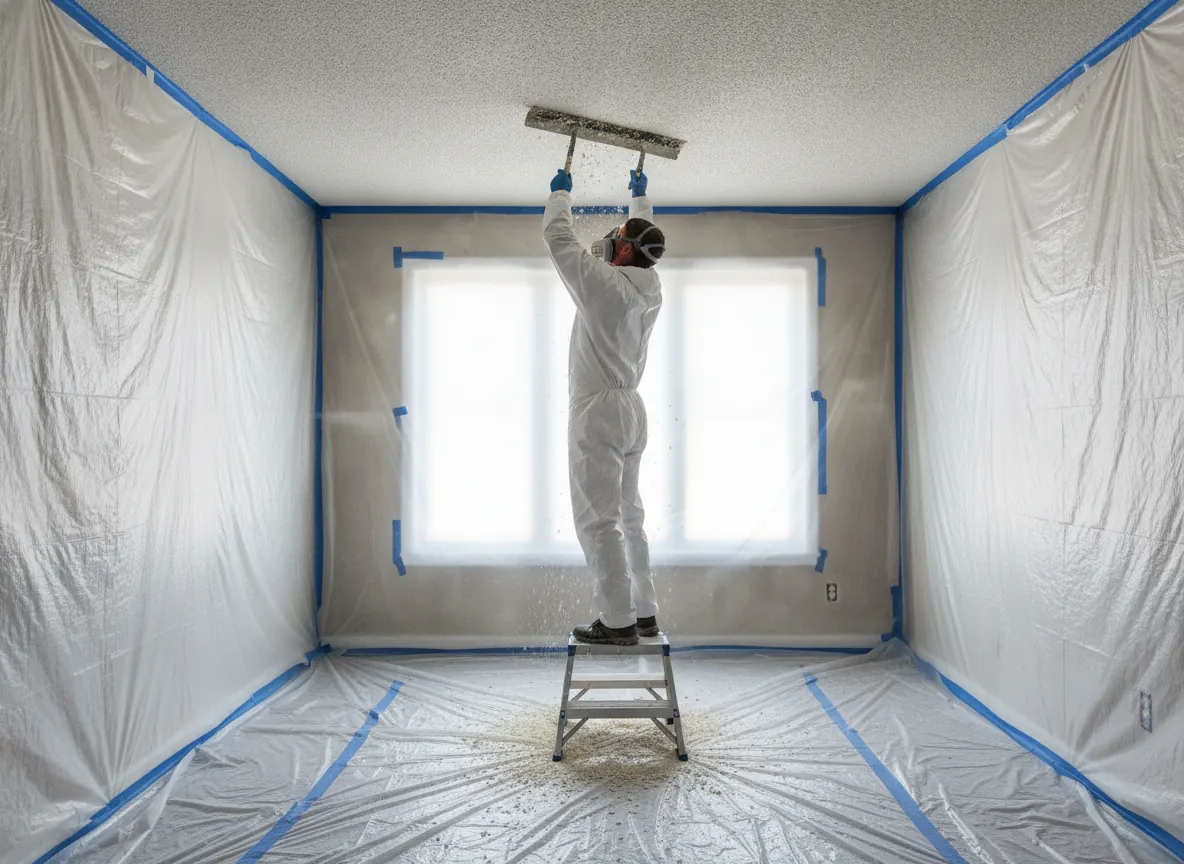
Lay plastic sheeting on the floor and up the walls, tape it at the top, and seal doorways so dust and debris stay in the room.
Mist a small section
Lightly spray a few square feet with water and let it soak in. Too much water can damage the drywall underneath.
Scrape
Use a wide scraper held at a low angle to take the texture off without gouging the drywall. Work section by section.
Bag debris and clean up
Bag wet debris as you go, then roll the plastic inward and vacuum with a HEPA-filtered vacuum.
Repair, finish, prime and paint
Expect to patch gouges and seams, then skim coat or retexture before primer and paint. See what to do after popcorn ceiling removal.
One common snag: popcorn that has been painted over. Paint seals the texture, so water can't soak in and scraping gets much harder. Painted ceilings often take more time and effort, and sometimes a different approach.
The mess, the containment and the time
The scraping is the short part. Most of the effort goes into everything around it.
Mess: wet popcorn falls in heavy clumps and sticks to everything it lands on, and dry dust drifts. Without good containment it ends up on walls, in carpet and in the air handler.
Containment: sealing a room properly with plastic takes real time, and it has to be done well. Gaps at the top of the wall sheeting or around a door let dust into the rest of the house.
Time: there's no reliable hour count that fits every house. Room size, ceiling height, whether the popcorn was painted, and how much repair the drywall needs all change it. Working overhead is tiring, and finishing work such as skim coating has to dry between coats, which takes longer in Gainesville's humid months from about mid-May through September. A DIY job that starts on a Saturday often runs well past the weekend once repairs and painting are included.
DIY vs professional: how the costs compare
| Item | Typical range |
|---|---|
| Asbestos testing (professional) | $250–$850 (lab analysis $20–$100 per sample) |
| Professional removal (tested negative) | $1–$4 per sq ft |
| Bedroom (~200 sq ft) | $200–$800 |
| Living room (~330 sq ft) | $330–$1,320 |
| Smooth finish skim coat | $1–$1.50 per sq ft |
| Ceiling painting after removal | $1–$3 per sq ft |
| Debris disposal | $100–$500 |
Typical ranges from national cost guides, 2024–2026. Estimates only; the real price comes from an in-home look.
Doing it yourself saves labor, but not everything. You still pay for testing, plastic sheeting, tape, scrapers, a sprayer, compound, primer, paint and disposal, plus your own time. The finishing is where many DIY jobs fall short: an uneven skim coat shows under raking light. Our popcorn ceiling removal cost guide has a calculator to compare against.
When DIY is reasonable
- The ceiling has been tested by a professional and the result is negative.
- It's a small room, such as a bathroom, closet or small bedroom, with a standard-height ceiling.
- The popcorn has not been painted, so it softens with water.
- You're comfortable working on a ladder overhead for long stretches.
- You plan to retexture, or you have drywall finishing experience if you want smooth.
- The room can be emptied and sealed off for several days.
When hiring a pro makes more sense
- Multiple rooms, open living areas or vaulted ceilings.
- Painted popcorn, or drywall that turns out to need significant repair.
- You want a smooth, Level 5-style finish that holds up under window light.
- The home is occupied and you need the work contained and finished on a schedule.
- You're preparing a rental or a home for sale. The Florida homeowner exemption above applies only to a residence you occupy that is not for sale or lease.
If the ceiling tested negative and you'd like a price to compare against DIY, request a free quote.
Frequently asked questions
Can I remove a popcorn ceiling myself?
If a professional test shows no asbestos, many homeowners remove small areas themselves with water, a wide scraper and good plastic containment. Test first: the EPA advises treating suspect material as asbestos and leaving it alone until it's tested, and says removal of asbestos material must be done only by trained, accredited professionals. This isn't legal advice; check with the agency or a licensed professional.
Is a DIY asbestos test kit good enough?
DIY kits cost less than professional testing, but the EPA's homeowner guidance says samples should be taken by trained, accredited professionals and that taking samples yourself is not recommended. Alachua County EPD also advises having suspect material sampled by a qualified professional. National guides put professional testing at about $250–$850, with lab analysis at about $20–$100 per sample.
Why is painted popcorn so hard to remove?
Paint seals the texture, so water can't soak in and soften it before scraping. That makes the job slower and more physical, and it raises the risk of gouging the drywall underneath. Painted popcorn is one of the most common reasons a DIY removal stalls, and it should still be tested for asbestos before anyone starts scraping.