
Once the popcorn comes down, you still have to decide what your ceiling should look like. Scraping off acoustic texture rarely leaves a perfect surface, so the finish you pick next does a lot of the work. This guide compares the three finishes Gainesville homeowners ask us about most: a smooth skim-coated ceiling, knockdown texture and orange peel texture. We cover how each one looks, how well it hides flaws, what national cost guides say it typically costs, and what North Central Florida's humid rainy season means for drying time.
Why popcorn ceiling removal and retexture usually go together
Popcorn texture was often sprayed over drywall that was never finished to a high standard, because the bumpy coating hid tape lines, seams and uneven joints. When the texture is scraped away, those details show again. You may also find scraper gouges, nail pops, old water stains, or patched holes where a ceiling fan or light fixture was moved.
That leaves two paths. You can bring the ceiling up to a smooth finish with skim coating, or you can apply a lighter, more current texture that blends small imperfections. Either way, the ceiling then gets primed and painted.
Before any of this starts, the existing popcorn should be tested. Our approach is simple: test first. If the ceiling tests negative, we remove it; if it tests positive, a licensed asbestos abatement contractor handles removal, and we can help arrange testing and referrals. Our asbestos testing page explains how that works.
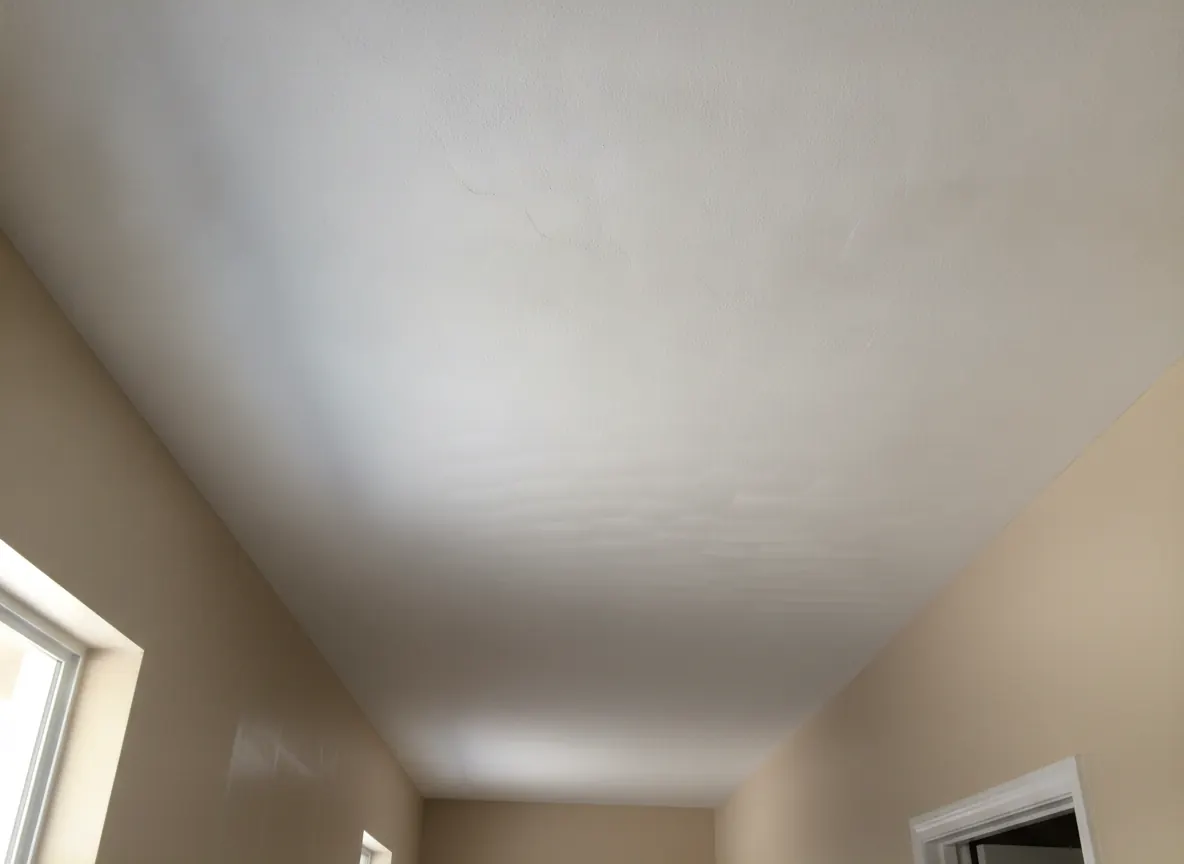
Smooth ceiling finish: the cleanest look
A smooth ceiling is what most people picture when they say they want the popcorn gone. To get there, thin coats of joint compound are skimmed across the entire surface, sanded between coats and checked with a bright light held at a low angle. This is often called a Level 5 finish: instead of only taping and coating the seams, the whole ceiling gets a skim coat.
How it looks: clean, modern and bright. Smooth ceilings reflect light evenly, which helps rooms feel open and suits most current interior styles.
Hiding flaws: this is its weak point. A smooth ceiling hides nothing on its own, so the skim coat has to fix the flaws. Light raking across the ceiling from a window or a sliding door to the lanai will reveal ridges and dips that a textured ceiling would disguise. That is why smooth finishing takes more labor than retexturing.
Typical cost: national cost guides put a smooth-finish skim coat at about $1–$1.50 per square foot, on top of removal. Our smooth ceiling finish page explains the process in more detail.
Knockdown texture: the most forgiving option
Knockdown is made by spraying or splattering joint compound onto the ceiling, letting the peaks set slightly, then flattening them with a wide knockdown knife or trowel. The result is a flattened, mottled pattern that some people compare to stucco or stone.
How it looks: textured but low-profile, with a handmade feel. It is a familiar look in Florida homes and doesn't read as dated the way popcorn does.
Hiding flaws: very good. The irregular pattern breaks up light, so minor seams, small patches and slight waves in the drywall become hard to spot. If the drywall under your popcorn turns out to be rough, knockdown is often the practical answer.
Typical cost: national cost guides list retexturing, including knockdown and orange peel, at about $0.60–$2 per square foot.
Orange peel texture: subtle and easy to live with
Orange peel is a thin sprayed texture with a fine, dimpled surface, much like the skin of an orange. It is lighter than knockdown and is used on walls as often as ceilings, so it can tie a ceiling into textured walls in the same room.
How it looks: close to smooth from across the room, with a soft texture up close. It is a good fit when you want something cleaner than knockdown without paying for a full smooth finish.
Hiding flaws: moderate. Orange peel masks tiny imperfections and light sanding marks, but larger seams or uneven patches can still show, so the ceiling needs reasonable prep first.
Typical cost: covered by the same $0.60–$2 per square foot retexture range. Both textures are covered on our knockdown and orange peel retexture page.
Smooth vs knockdown vs orange peel at a glance
| Finish | Look | Hides flaws | Typical cost |
|---|---|---|---|
| Smooth (skim coat) | Clean, modern, bright | Least: flaws must be fixed | $1–$1.50 per sq ft |
| Knockdown | Flattened, mottled | Most | $0.60–$2 per sq ft (retexture) |
| Orange peel | Fine, dimpled | Moderate | $0.60–$2 per sq ft (retexture) |
Typical ranges from national cost guides, 2024–2026. These are estimates; your real price comes from an in-home look.
What does popcorn ceiling removal and retexture cost in total?
The finish sits on top of removal, primer and paint. These are the main line items national cost guides list, so you can sketch a budget:
| Item | Typical range |
|---|---|
| Asbestos testing (professional) | $250–$850 (lab analysis $20–$100 per sample) |
| Popcorn removal (tested negative) | $1–$4 per sq ft |
| Smooth finish skim coat | $1–$1.50 per sq ft |
| Retexture (knockdown / orange peel) | $0.60–$2 per sq ft |
| Ceiling painting after removal | $1–$3 per sq ft |
| Debris disposal | $100–$500 |
Typical ranges from national cost guides, 2024–2026.
For scale, national guides put removal alone at about $200–$800 for a bedroom of roughly 200 square feet, and $330–$1,320 for a living room of roughly 330 square feet; the finish and paint add to that. Ceiling height, how much drywall repair is needed, whether the popcorn was painted and how much furniture has to move all change the number. Our popcorn ceiling removal cost guide has the full table and a calculator, or you can request a free quote for a price based on your actual rooms.
A note on Gainesville's humidity and rainy season
Joint compound and texture cure by giving up moisture to the air, so the weather matters. NOAA's 1991–2020 normals for Gainesville Regional Airport show about 48 inches of rain a year, with June through September bringing roughly 53% of it. Humidity runs high from about mid-May through September, with frequent afternoon thunderstorms.
That doesn't rule out summer ceiling work. It means planning for it: keeping the air conditioning running so the indoor air stays drier, leaving more time between coats, and not rushing primer onto compound that isn't fully dry. A smooth finish involves several skim coats, so it is the most sensitive to drying time; sprayed textures usually go on in fewer passes. If your schedule is tight, ask about timing when you get your quote.
Which finish should you choose?
- Smooth if you want the most modern look, are preparing to sell, or have bright rooms with lots of natural light, and you're comfortable paying for the extra labor.
- Knockdown if the drywall underneath is rough or heavily patched, or you want the most forgiving finish for the money.
- Orange peel if you want a subtle texture, you're matching textured walls, or the ceiling is in fair but not perfect shape.
- Mix and match if it suits the house: smooth in the main living areas, texture in bedrooms, hallways or closets.
Whichever you pick, plan on primer and paint afterward; our guide to what to do after popcorn ceiling removal walks through those steps. If you are still deciding whether to take the texture down at all, read remove, cover or encapsulate a popcorn ceiling.
Frequently asked questions
Is a smooth ceiling more expensive than knockdown?
Usually, yes. National cost guides list a smooth skim coat at about $1–$1.50 per square foot and retexturing at about $0.60–$2 per square foot, but smooth finishing generally takes more labor because every flaw has to be fixed rather than hidden. The condition of the drywall after removal drives the real price, so an in-home look gives you the actual number.
Which ceiling texture hides imperfections best?
Knockdown generally hides the most. Its flattened, irregular pattern breaks up light, so small seams, patches and slight waves are hard to see. Orange peel hides minor marks but can show larger flaws. A smooth finish hides nothing by itself, so the drywall has to be skimmed and sanded flat before primer and paint go on.
Can you retexture right over a popcorn ceiling?
New texture needs a sound, clean surface, so popcorn is normally removed first, and it should be tested before anyone scrapes it. The EPA advises that if in doubt, you treat the material as if it contains asbestos and leave it alone. If a test is positive, a licensed asbestos abatement contractor handles removal. Covering the ceiling with drywall is another route.
Does humidity affect how long ceiling texture takes to dry?
Yes. Joint compound and texture dry by releasing moisture, so humid air slows them down. In Gainesville, humidity stays high from about mid-May through September. Running the air conditioning and allowing extra time between coats helps, especially for a smooth finish, which needs several skim coats that must be fully dry before primer.